

The Lisbon Earthquake of 1755 and the Urban Revolution of the Marquês de Pombal
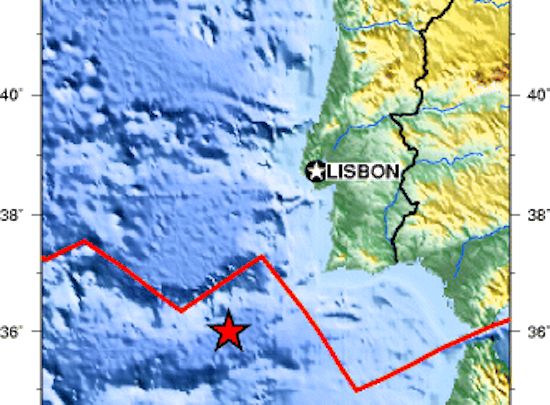
Photo: A map from the USGS showing the location of the 1755 Lisbon earthquake (© USGS) [Public domain]
The earthquake that shook Lisbon in 1755 was not only one of the city's greatest tragedies but also a catalyst for an unprecedented urban transformation. This devastating event, which destroyed much of the Portuguese capital, led to an architectural renewal spearheaded by the Marquês de Pombal, shaping Lisbon as we know it today.
The meticulously planned reconstruction introduced innovative urban concepts that would go on to influence cities worldwide. The story behind this reconstruction is a testament to resilience and innovation in the face of adversity.
Social and Philosophical Consequences
The 1755 earthquake shook not only the buildings of Lisbon but also the intellectual certainties of Europe. The disaster occurred on the morning of 1 November, All Saints' Day, when many people were in churches. The fact that crowded temples collapsed raised profound questions about divine providence, fate, and justice.Enlightenment
philosophers began to intensely debate the meaning of the tragedy. The French thinker Voltaire wrote the famous Poème sur le désastre de Lisbonne, in which he criticized the optimistic idea that “everything happens for the best.” Later, he also referenced the disaster in his satirical work Candide, using the earthquake as a symbol of the absurdity of simplistic explanations for human suffering. On the other hand, the German philosopherImmanuel Kant
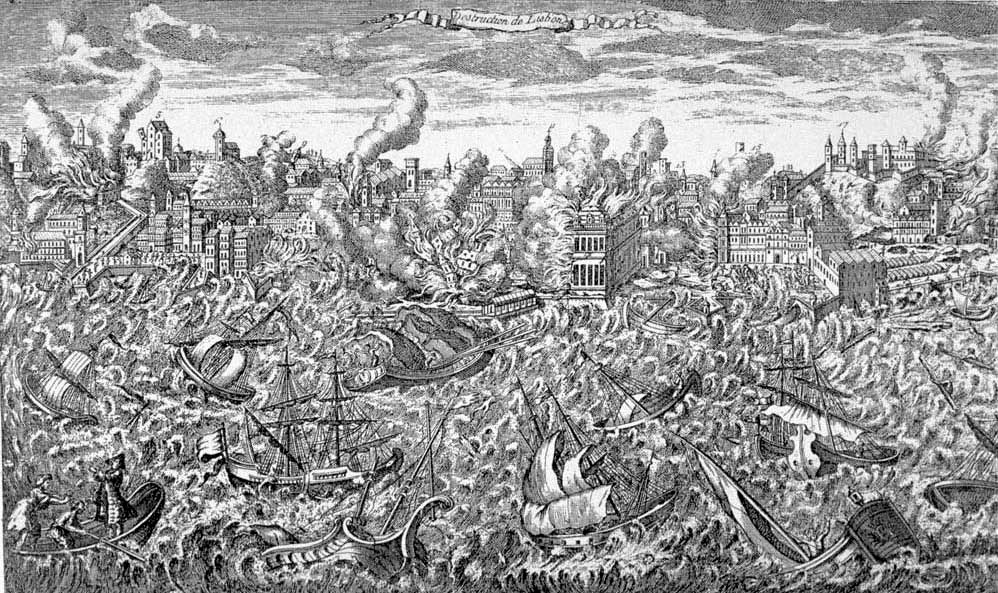
studied the phenomenon from a more scientific perspective. He published several texts attempting to explain the natural causes of earthquakes, contributing to the early development of seismology . Thus, the Lisbon disaster helped stimulate an important intellectual shift: the search for scientific explanations instead of purely religious ones. Lisbon, Portugal, during the great earthquake of 1 November 1755. This copper engraving, made that year, shows the city in ruins and in flames. Tsunamis rush upon the shore, destroying the wharfs. The engraving is also noteworthy in showing highly disturbed water in the harbor, which sank many ships (© Unknown authorUnknown author) [Public domain]Advances in Disaster Management
The administrative response to the earthquake was also pioneering. Under orders from the
Marquês de Pombal
, swift measures were taken to prevent epidemics and restore order. One of the phrases most attributed to the minister sums up his pragmatic approach: “Bury the dead and take care of the living.”Soldiers were mobilized to maintain security, prevent looting, and organize the rescue of victims. Additionally, the government conducted one of the first systematic inquiries into a natural disaster
. Questionnaires were sent throughout the country to gather information on the intensity of the tremor, duration, sea behavior, and damage caused. This survey became a landmark in the history of scientific investigation of earthquakes. Rebuilt LisbonOver time, the new Lisbon became a symbol of modernity and urban planning. The
Baixa Pombalina
came to represent an innovative vision of a city: organized, safe, and functional. The construction system known as “gaiola pombalina” (Pombaline cage) was surprisingly tested — troops marched around models to simulate seismic vibrations, assessing the structures' resistance. Another central element of the new city was the monumental Praça do Comércio (Commerce Square)
, open to the Rio Tejo (Tagus River). With elegant arcades and a large public square, it symbolized the connection between Lisbon, maritime trade, and the Portuguese overseas empire. Memory and LegacyToday, more than two centuries later, the 1755 earthquake remains present in the Portuguese collective memory. The event profoundly marked the city's history and influenced the development of modern policies in urban planning, engineering, and risk management.
Lisbon, once in ruins, became an example of how cities can be reborn after catastrophes. The reconstruction led by the
Marquês de Pombal
demonstrated that planning, science, and leadership can transform destruction into progress. Thus, the story of the 1755 earthquake remains not only a tragic chapter but a powerful testament to the human capacity to rebuild, learn, and evolve in the face of adversity. Marquês de Pombal demonstrou que planejamento, ciência e liderança podem transformar destruição em progresso. Assim, a história do terremoto de 1755 permanece não apenas como um capítulo trágico, mas como um poderoso testemunho da capacidade humana de reconstruir, aprender e evoluir diante da adversidade.
The earthquake that shook Lisbon in 1755 was not only one of the city's greatest tragedies but also a catalyst for an unprecedented urban transformation. This devastating event, which destroyed much of the Portuguese capital, led to an architectural renewal spearheaded by the Marquês de Pombal, shaping Lisbon as we know it today.
Views on this article
0 comments
Leave a comment
Your email will not be published. Required fields are marked with (*).
